The Film Room
November 8, 2026 · Pete Macias, Dark Reel Studios
What Is 11 Personnel in Football? How to Read an Offense Before the Snap
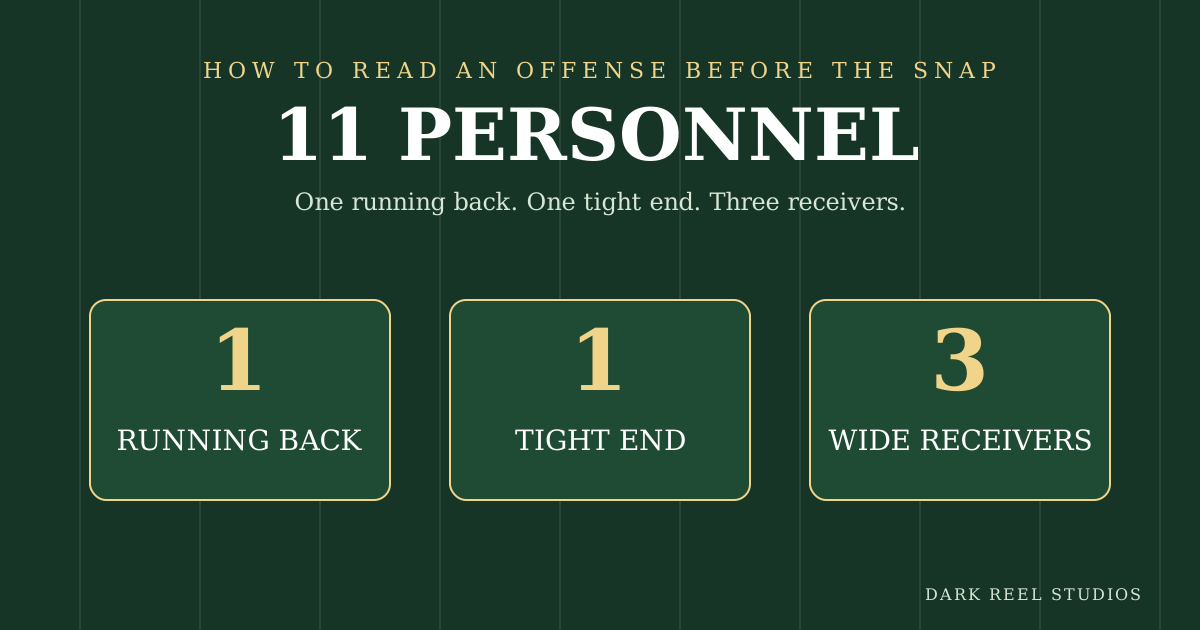
Before every snap, the offense answers a question you can see from the couch: who did they send out there? Not where they lined up. Who.
One running back, one tight end, three wide receivers. That's 11 personnel. Once you can spot it — and the packages that aren't it — you can start watching how the defense responds.
What is 11 personnel in football?
11 personnel is an offensive grouping with one running back, one tight end and three wide receivers, plus the quarterback and five offensive linemen.
The two-digit code works the same way on Friday nights as it does on Sundays. As PFF's Brent Rollins explained in a Teaching Month primer: of the 11 offensive players, five linemen and the quarterback take six spots. The remaining five are some mix of running backs, tight ends and receivers. The first digit is the number of running backs. The second digit is the number of tight ends. Wide receivers fill out the rest.
So "11" means 1 RB + 1 TE, which leaves 3 WR. "12" means 1 RB + 2 TE, which leaves 2 WR. The receivers aren't in the name. You count them by subtraction.
Sharp Football uses the same code in its personnel tracker: first digit running backs, second digit tight ends.
Personnel is who. Formation is where.
This is the distinction that trips people up. 11 personnel tells you which skill players are on the field. It does not tell you the formation. Those three receivers might be split out, bunched to one side, or stacked. The running back might be beside the quarterback in shotgun or set behind him.
PFF is careful about that split: personnel is "specific to the players on the field and not factoring in the next level of detail — the formation."
That's why a team can run and pass out of the same personnel. The grouping sets the menu. The formation and the call pick the play.
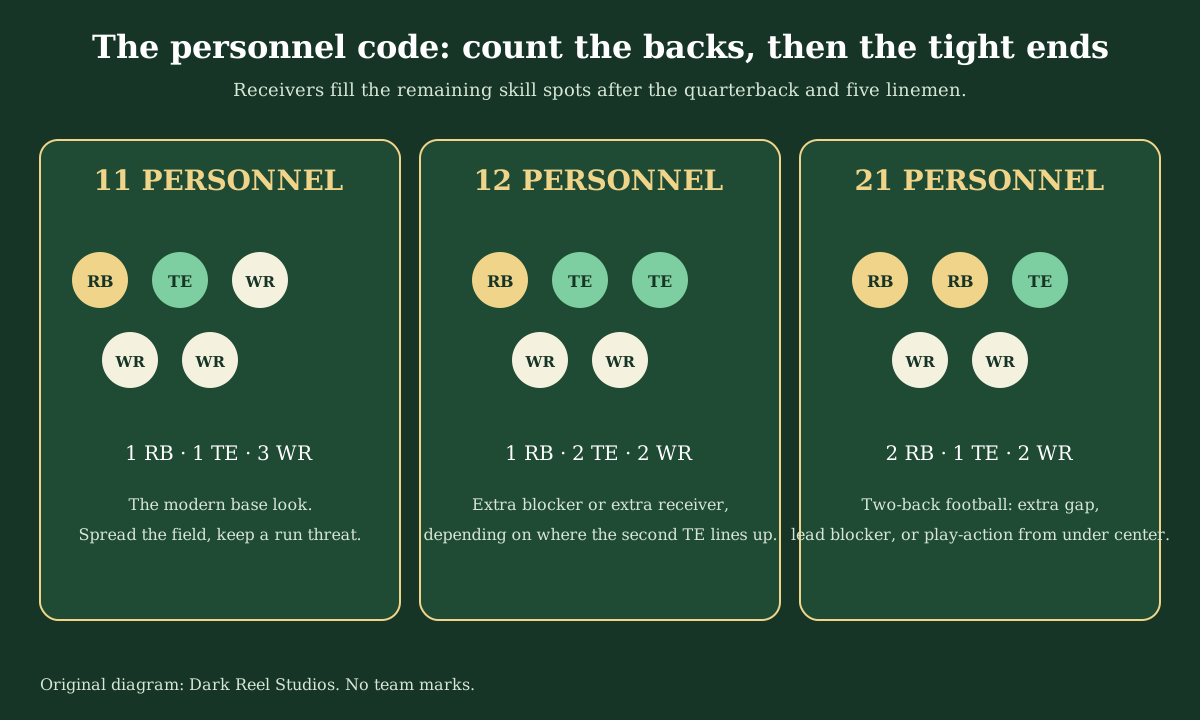
The personnel cheat sheet
- 11 personnel — 1 running back, 1 tight end, 3 wide receivers: The modern base. Spread the defense, keep a run threat, create a mismatch with the tight end or the slot.
- 12 personnel — 1 running back, 2 tight ends, 2 wide receivers: Extra blocker or extra receiver, depending on whether the second tight end stays in or splits out.
- 13 personnel — 1 running back, 3 tight ends, 1 wide receiver: Heavier. Often a run look, unless one of those tight ends is really a receiver in a different jersey.
- 21 personnel — 2 running backs, 1 tight end, 2 wide receivers: Two-back football: a fullback or second back in the backfield. Extra gap to account for.
- 22 personnel — 2 running backs, 2 tight ends, 1 wide receiver: Short-yardage and goal-line flavor. Extra gaps, extra blockers.
- 10 personnel — 1 running back, 0 tight ends, 4 wide receivers: Four receivers, no tight end. Passing-down flavor.
Why offenses use 11 personnel
Three wide receivers can stretch a defense across the field while a running back preserves a run threat. The tight end can block, release into a route or align away from the line. The grouping gives the offense several ways to use the same players without substituting.
That flexibility does not guarantee a favorable matchup. The defense's personnel, alignment and post-snap movement still matter.
What 11 personnel tells you before the snap
1. The defense is about to match it. Three receivers usually pull a fifth defensive back onto the field — nickel. PFF describes the substitution pattern as a hockey-style line change: the offense sends its 11 out, and the defense substitutes based on who it sees. A linebacker who can take on a tight end is not the same player as a nickel corner who can run with a slot receiver.
2. The box often gets lighter. Nickel usually means one fewer linebacker near the line. That can open run lanes if the offense hands it off, which is why good 11-personnel teams run the ball out of a "passing" look on purpose.
3. The tight end becomes the chess piece. In 11, that single tight end can stay in to block, leak into the flat, or run a seam. The defense has to decide whether to treat him as a blocker or a receiver, and it often has to decide before the snap.
What it does not tell you: run or pass. Plenty of 11-personnel snaps are designed runs. Plenty of 12-personnel snaps are play-action shots. Watch who is on the field first. Then watch where they line up. Then watch the safeties, the same way we covered in how to read a defense pre-snap.
What the other groupings are asking the defense to do
12 personnel: Extra tight end. If he attaches to the line, think run and play-action. If he splits out, a defense that stayed in base (an extra linebacker) may be stuck covering a receiver.
13 personnel: Three tight ends. Often heavier and closer to the line. Some staffs now use it enough that defenses cannot treat it as an automatic short-yardage tell.
21 personnel: Two backs. Extra gap, extra lead blocker, more play-action from under center. When you see it, look for the second back's first step.
22 personnel: Two backs and two tight ends. You will see this near the goal line and on short yardage.
10 personnel: Four wide, no tight end. Passing-down flavor. The defense may use nickel (five defensive backs) or dime (six), depending on the situation.
How to read it from the couch this weekend
You do not need an all-22 feed.
1. After the offense breaks the huddle, count skill players. How many look like running backs? How many look like tight ends? The rest are receivers. 2. Say the code out loud. "That's 11" or "That's 12." 3. Watch the defense's substitution. If a linebacker runs off and a smaller defensive back runs on, you just saw nickel answer 11 personnel. 4. Then check the safeties. Personnel tells you the offense's tools. Safety depth tells you how the defense is using its own.
Try it during the next game you watch. The same exercise works on a Saturday college broadcast and on a Friday night high school stream. The two-digit code does not change with the level.
Keep studying the tape
Personnel tells you who. Coverage tells you where the help is. Pair this with our guide on how to read a defense pre-snap and our explainer on EPA, then test yourself with daily football games in The Play Hub. New to the terms? The Dark Reel football glossary has you covered, and the Film Room Playbook and Strategy Guide are in The Store. Find The Film Room on the App Store.
See you in the room.
— Pete Macias, Dark Reel Studios