The Film Room
November 15, 2026 · Pete Macias, Dark Reel Studios
What Is a Fire Zone Blitz? How Defenses Send Five and Still Play It Safe
Third and 8. The defense walks a linebacker up to the line, then a safety. It looks like everybody is coming. The quarterback sees it, takes a quick drop and throws hot to the spot the blitz should have emptied.
Except somebody is standing there. A defensive lineman who was supposed to be rushing is now sitting in that throwing lane.
That's the idea behind the fire zone. It's pressure that doesn't leave the defense naked behind it.
What is a fire zone blitz?
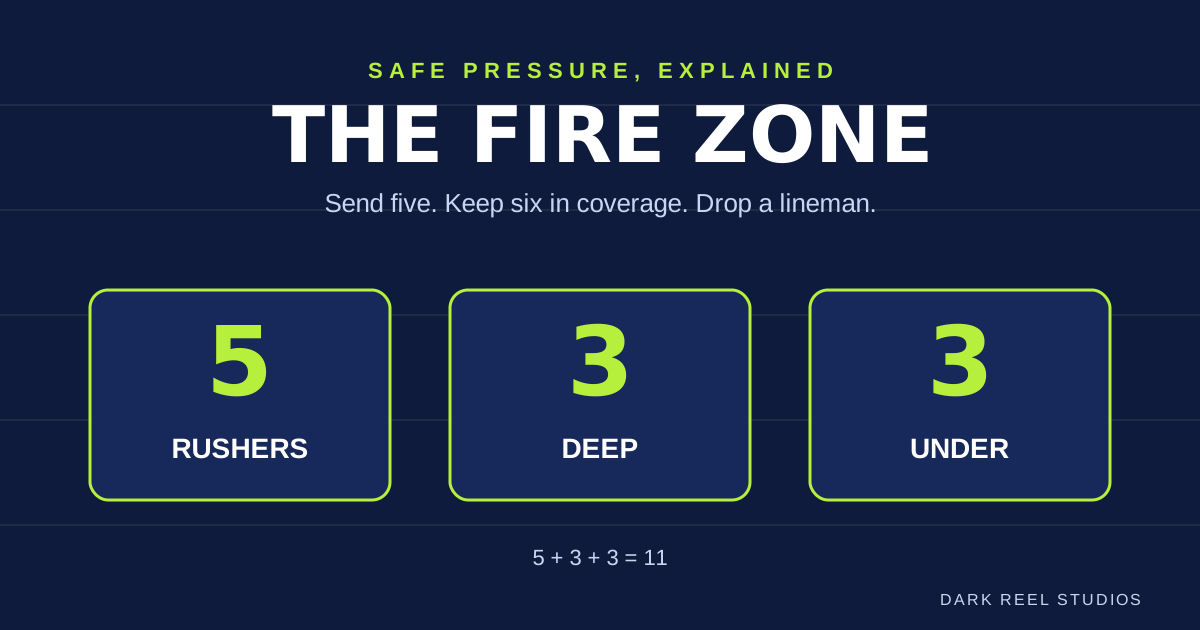
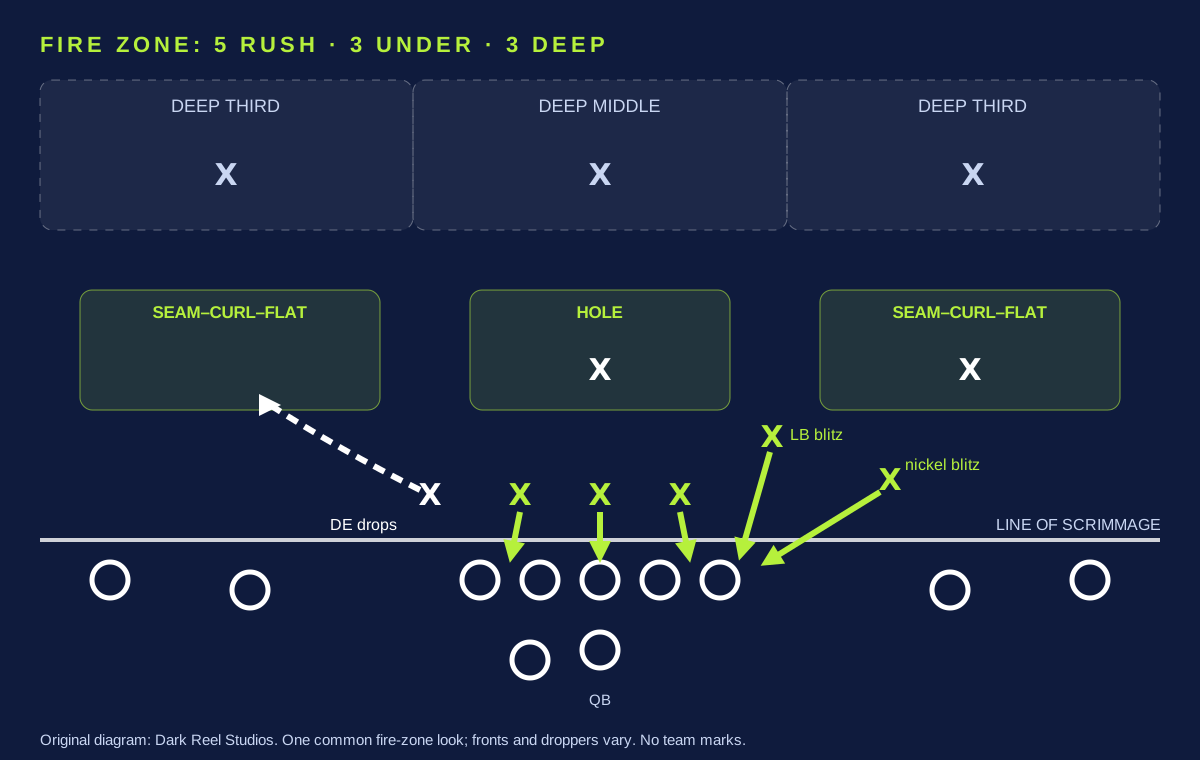
A fire zone is a zone blitz that rushes five and plays three deep, three underneath behind it. Count it: five rushers + three deep + three under = 11.
A zone blitz is the broader family. As the Wikipedia entry on the zone blitz summarizes it, the defense sends extra rushers while a player the offense expects to rush, often a defensive lineman, drops into zone coverage instead. The fire zone is the most common version: five come, six cover, and the six are split three deep and three under.
The three deep defenders usually look like Cover 3: two corners and a safety each take a deep third of the field. The three underneath defenders take the short areas. A typical split is one player on each side covering from the seam out toward the curl and flat, plus one player in the middle "hole."
Why would a defensive lineman drop into coverage?
Because pass protection is built on assignments. The offensive line and backs decide before the snap who blocks whom. A normal blitz adds rushers, and the defense usually has to play man-to-man behind it, because it's out of bodies.
The zone blitz changes the math. Bill Arnsparger, who coached the Miami Dolphins' "No-Name Defense," described it in his book Arnsparger's Coaching Defensive Football, quoted in Chris B. Brown's Grantland breakdown "Controlled Chaos": linebackers and defensive backs blitz, "defensive linemen who usually rush are now dropping out to short inside zones to replace" them, and "because of the blitzer's path, it is difficult for the offensive linemen to adjust."
So the offense blocks the five it expected. One of those five drops out. One it didn't expect comes in. The defense still rushes five, and it still has six players in coverage.
Where the fire zone came from
Bill Arnsparger built the foundation in Miami. Per the same Grantland piece, Arnsparger used linebacker Bob Matheson as a defensive end who could rush or drop. "With Bob there, with linebacking skills," Arnsparger said, "we were able to rush five guys and cover with six. That's what you need to run a zone blitz."
Dick LeBeau turned it into a system. LeBeau, then defensive coordinator in Cincinnati, went to see Arnsparger at LSU. Brown quotes LeBeau, via Tim Layden's book Blood, Sweat and Chalk: "Bill's catchphrase was that he wanted to get 'safe pressure' on the quarterback." LeBeau later made zone pressure famous as the Pittsburgh Steelers' defensive coordinator. He is in the Pro Football Hall of Fame, Class of 2010, for his 14 seasons and 62 interceptions as a Lions cornerback, and he coached 35 seasons in the NFL before retiring after 2017.
"Safe pressure" is the best two-word definition of a fire zone you'll find.
The most famous play in that family wasn't even the call
Super Bowl XLIII, end of the first half. Arizona had first-and-goal at the Pittsburgh 1 with 18 seconds left. LeBeau, by his own account, called a max blitz.
James Harrison didn't rush. "We had a play call where we were basically on a max blitz," Harrison told NFL.com. "Kurt had to get it out, so he had to throw a quick slant in or out, and I guessed on in." Kurt Warner threw hot toward Anquan Boldin. Harrison was standing in the lane. He returned it 100 yards for a touchdown, and Pittsburgh won 27–23.
It was a freelance read, not a designed fire zone. But it shows exactly why fire zones work: the quarterback throws to where the rusher should have come from, and a dropper is waiting there.
Where the fire zone is weak
No call is free. The weak spots are predictable:
- A lineman in space. Defensive linemen are the biggest, slowest players on the field. If a quick slot receiver or an athletic tight end gets matched on the dropping end, that's an easy throw.
- Three underneath is thin. Regular Cover 3 usually has four underneath defenders. A fire zone has three. Quick game, such as slants, option routes and quick outs, can attack the gaps between them. Coach Hoover's write-up on the origin of "simulated pressures" puts it bluntly: fire zones "always leave you one man short in coverage."
- Run plays. When a lineman drops, he isn't stopping the run. That's why fire zones show up most on passing downs.
That last weakness also explains the newer cousin, the simulated pressure: rush four, but bring one from an unexpected spot and drop a lineman. It looks like pressure without giving up the extra coverage defender. Same Arnsparger DNA.
How to spot a fire zone from the couch
You don't need the all-22. Watch one passing down this way:
1. At the snap, count rushers. Five? Keep going. 2. Find the dropper. Look for a defensive end or tackle backpedaling instead of rushing. That's your tell. 3. Check the deep shell. Do both corners bail and a single safety sit in the middle? That's three deep. 4. Watch the quarterback's first throw. If he throws quickly to the area the blitzer left, look for the dropper or the hole player arriving there.
Steelers at Eagles is on CBS Sunday at 1 PM ET. Pick one third down and run the checklist.
Keep studying the tape
The fire zone's back end is Cover 3, so start with how to read a defense pre-snap. Want to know what personnel a defense is reacting to? See what 11 personnel means. New to a term? The Dark Reel football glossary has it. Then test yourself with daily football games in The Play Hub, or grab The Film Room on the App Store.
See you in the room.
— Pete Macias, Dark Reel Studios